
Washington County Arrest Warrants
An arrest warrant gives an officer the power to take someone into custody on the order's terms. A magistrate or judge in Washington County reviews a sworn complaint and the probable-cause showing behind it. Virginia Code §§ 19.2-71 and 19.2-72 set out who may issue process and what the complaint and warrant must contain. Once issued, the case may sit in GDC, move up to Circuit, or belong in JDR under that court's jurisdiction. Serving the warrant is one thing. The hearing on the charge itself is another.
Probable Cause Starts With a Sworn Complaint
Virginia Code § 19.2-72 lays out how this works. A complainant swears out a written statement, and the issuing officer weighs whether probable cause supports it. The warrant names the person and the offense, then directs an authorized officer to execute it. The Washington Magistrate Office confirms that local magistrates review probable cause and issue arrest, search, and civil warrants. Not every piece of paper behind the warrant is public, though. Investigative material, sealed files, juvenile matters, and protected details can stay closed even after a docket entry becomes visible. A docket result is not the full warrant packet, so ask the clerk in Washington County what part of the file you can actually see. The official Virginia Code § 19.2-72 gives the complaint and contents rule in full.
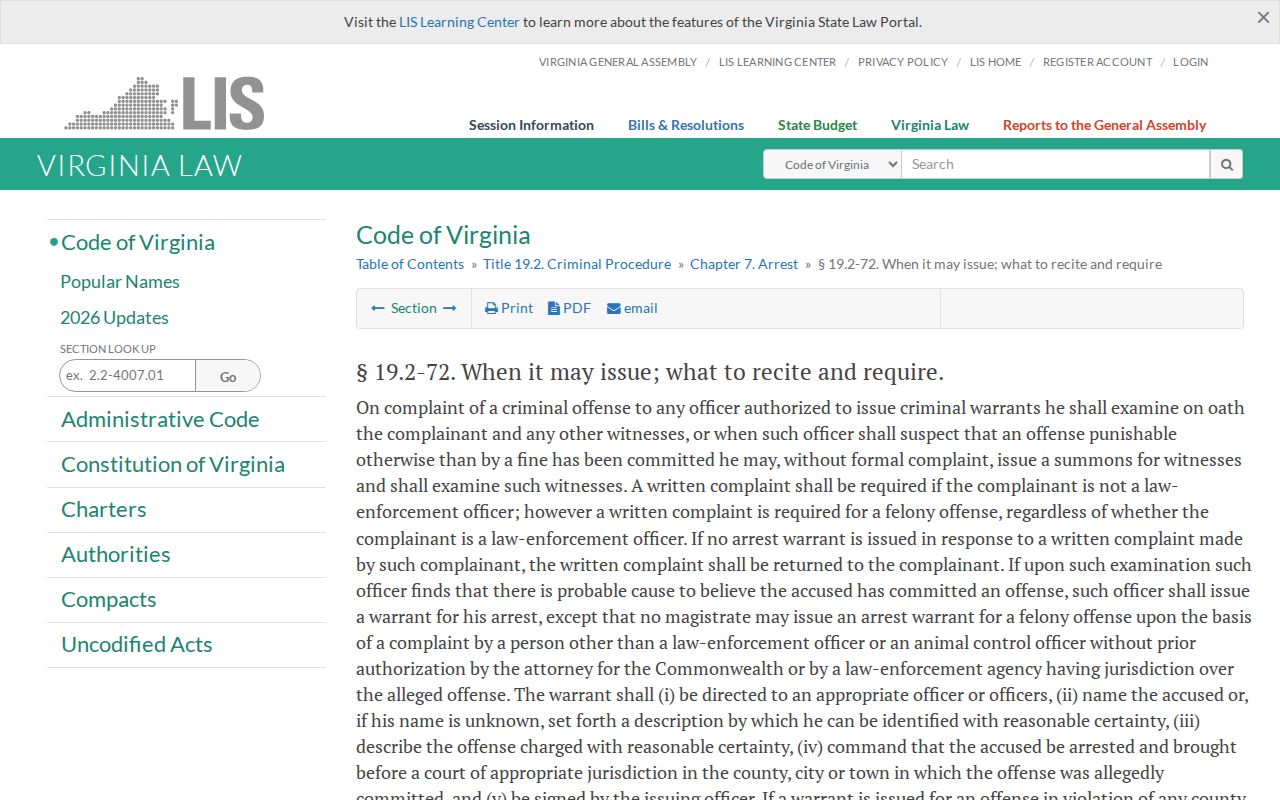
The statute spells out the required fields. It is not a copy of any Washington County warrant.
Fields in a Washington County Arrest Warrant
A docket may not show the warrant itself. The court-held document identifies the issuing officer, the offense, the case number, and the return court. Some application details can be restricted. What follows describes the fields generally, without a private person's name, address, or case.
| Case identifier | case number omitted; use the court's exact printed number. |
|---|---|
| Person field | Contains identifying details where lawfully public; no personal examples are reproduced here. |
| Charge or statute | Names the alleged offense or legal basis listed on the order. |
| Issuing authority | Shows the magistrate or judge who authorized the process. |
| Command and return | Directs an authorized officer and identifies the court for return. |
| Bond or appearance | Use the current court or magistrate instruction; no local bond schedule was found. |
Washington County Affidavits May Be Restricted
An affidavit, complaint, or supporting narrative is not automatically public just because a case number exists. Virginia law allows limits for law-enforcement records, active investigations, privacy, sealed matters, and juvenile files. The right question for the clerk is whether a specific document can be inspected, or whether only a docket entry gets released. Where you ask depends on the case. The Circuit Clerk at 189 East Main Street holds circuit felony records. GDC at 191 East Main handles adult misdemeanors, traffic, town ordinances, and preliminary felony matters. The JDR Clerk sits at 187 East Main, and that court provides no online case information. Whichever office in Washington County is named on the case controls the record question. The Circuit Court page posts the felony clerk's public contact route.
How Washington County Serves Arrest Warrants
The Sheriff's Criminal Warrant Service Unit serves criminal process for Washington County. The sheriff describes it as a separate unit, which keeps patrol deputies free for other calls. Town police handle local enforcement, but the county's service route runs through Central Dispatch at (276) 676-6277. Never try to serve a warrant yourself or confront someone on a list. After an arrest, custody and release questions go through the court or magistrate and the Southwest Virginia Regional Jail Authority's Abingdon facility. Each office holds its own piece. The clerk keeps the docket, the sheriff keeps service material, and the jail answers custody questions. Those contacts in Washington County are not interchangeable.
Service, Booking, and Court Return Differ
Service is the officer's execution step, nothing more. The officer's return may land in a court file, while booking and release details sit with the jail and the judicial officer. For custody questions, the official jail contact page lists the Abingdon facility at 15205 Joe Derting Drive, (276) 739-3520. Call the facility directly for custody and site-specific instructions. No complete bond schedule is published, nor is a list of accepted payment instruments, a release window, or a universal walk-in surrender policy. Confirm those details with the court or magistrate before you travel. The regional jail's Abingdon contact page is the place for facility routing.

That facility page helps with custody follow-up. It is not a court warrant search or bond schedule for Washington County.
Arrest Orders, Summonses, and Bench Warrants
These terms mark different steps. An arrest warrant authorizes custody on probable cause. A summons tells a person to appear, without necessarily authorizing an arrest. A bench warrant or capias can follow a missed court obligation. For the related FTA process, see the Washington County bench-warrant page.
| Feature | Arrest Warrant | Summons | Bench Warrant |
|---|---|---|---|
| Purpose | Authorizes custody under the order | Commands appearance on a stated date | Addresses missed court duty or another event |
| Basis | Sworn complaint and probable cause | Case-specific court process | Existing case or failure to comply |
| Issuer | Magistrate or judge | Court or authorized officer | Judge or authorized judicial officer |
| Next step | Confirm with counsel and issuing court | Appear as directed | Ask issuing court about motion or date |
Traffic Summons Rules Depend on the Offense
Virginia Code § 46.2-938 covers what happens when someone fails to comply with a traffic summons or notice. It addresses possible warrant process and DMV consequences. Section 19.2-258.1 draws a line between ordinary traffic infractions and traffic misdemeanors. An ordinary infraction generally does not turn into a warrant just because no appearance was made. So do not lump every unpaid ticket, missed date, FTA, warrant, or license consequence into one event. Read the citation and the case history first. Then ask the GDC clerk whether the matter calls for payment, an appearance, or separate process handling. The current text of Virginia Code § 46.2-938 is online.
What to Do With a Washington Arrest Warrant
Found out a Washington County warrant carries your name? Call a lawyer first, or phone the clerk of the court listed on the case. Ask if the warrant is still active and what your options are. A motion to recall or quash may be possible, and some cases need a magistrate or jail contact rather than a courthouse visit. Searching public records online tells you nothing about what happens when you walk in. If someone is already in custody, the court handles questions about the next hearing and bail.
Important: Do not test a suspected warrant by approaching law enforcement; ask counsel and the issuing court about a safe, lawful next step.
Washington County Bond Has No Public Schedule
Magistrates in Washington County set bail and decide which instruments they will accept, but the county publishes no bond schedule and no list of approved payment methods. The Circuit Court payment PDF handles fines and costs, not warrant bonds. So take your questions straight to the magistrate or the court on the case. If the person is in custody, the Abingdon jail is the next call. Before you post anything, nail down the details: the exact court, the case number, the bond type and amount, who is allowed to post it, what ID to bring, how payment must be made, the cutoff time, and the next court date. None of that is uniform across Washington County warrants. The magistrate office page and the jail contact page give you both local routes.